
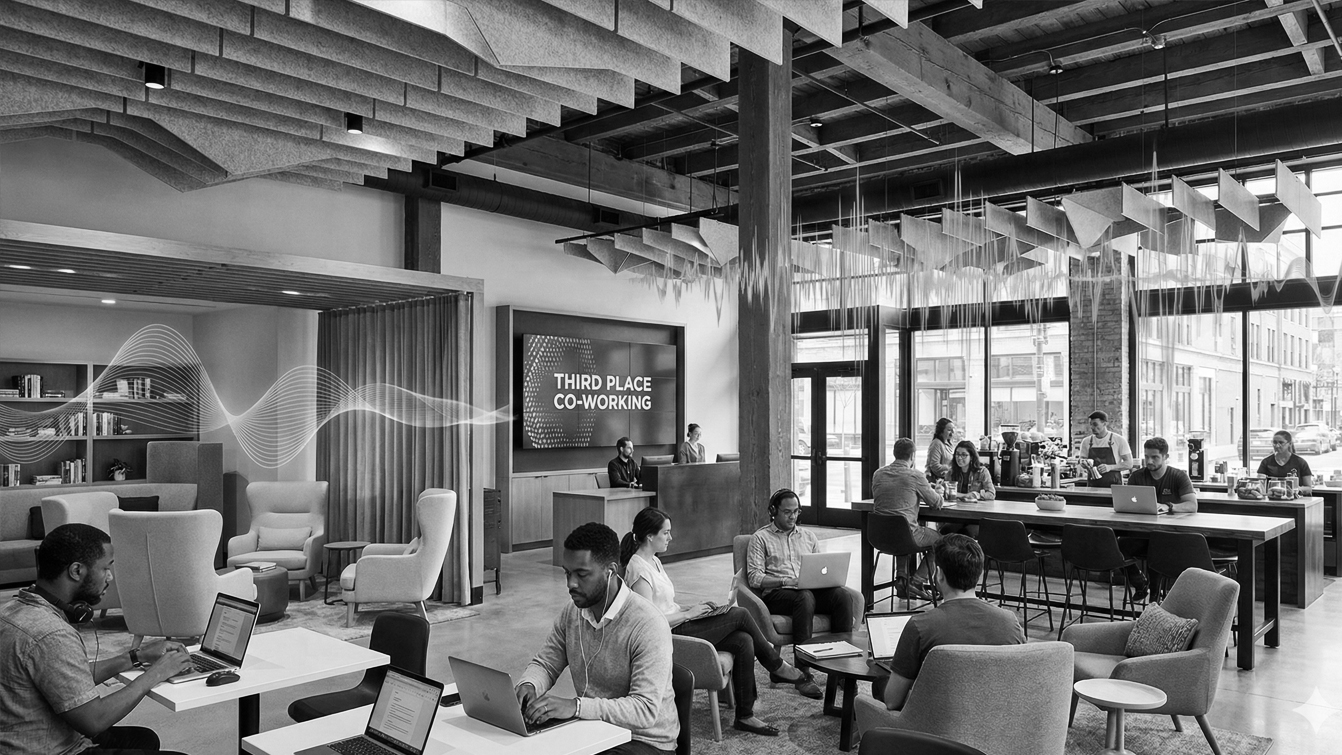
Hotel lobbies and coffee shops used to have clear roles. One was a place to pass through. The other, a place to refuel. Today, both have evolved into something far more complex—and far more valuable.
Across Canada and North America, these spaces are increasingly functioning as “third places”: informal environments that sit between home and office. Guests hold meetings in hotel lounges. Remote workers spend hours in cafés. Conversations, calls, collaboration, and quiet work now coexist in the same footprint.
But as many operators are discovering, the success of these spaces depends less on furniture layouts or Wi-Fi speeds—and far more on sound.
The Hidden Economics of Noise
In hospitality and food service, acoustics directly influence behavior. When a space is too loud or reverberant, people don’t linger. They shorten meetings, skip second purchases, and leave sooner than planned.
In contrast, spaces with controlled sound encourage dwell time. Guests settle in. Orders increase. Informal meetings turn into longer conversations. From a revenue perspective, acoustic comfort quietly supports both top-line sales and customer loyalty.
This relationship is becoming impossible to ignore. Recent hospitality research has shown that excessive background noise increases perceived stress and reduces overall satisfaction—even when service and design are strong. Guests may not always articulate the issue as “bad acoustics,” but they feel it.
Why “Open and Lively” Often Becomes “Uncomfortably Loud”
Many third places are designed with openness in mind: high ceilings, hard floors, minimal partitions, and strong visual sightlines. These choices create energy and transparency—but they also allow sound to travel unchecked.
In a hotel lobby acting as a co-working hub, this can mean:
- Phone calls bleeding into adjacent seating areas
- Background music competing with conversation
- Staff noise amplifying throughout the space
- Guests raising their voices just to be heard
The result is a rising acoustic baseline. As noise builds, so does cognitive fatigue—for guests and staff alike.
Designing for Multiple Sound Experiences, Not One
A key shift in third-place design is the move away from treating acoustics as uniform. Instead of trying to make the entire space “quiet,” designers are creating zones with distinct acoustic character.
Active areas—such as bars, service counters, and social seating—can support a higher energy level, provided reverberation is controlled. Meanwhile, quieter zones benefit from additional absorption and spatial separation, allowing for focused work or private conversation without isolation.
Ceiling treatments, soft furnishings, and suspended acoustic elements play an outsized role here. Because third places are often visually open, overhead solutions are especially effective at reducing reverberation while preserving flow and sightlines.
Acoustics as Part of the Brand Experience
Sound is increasingly recognized as part of brand identity. Just as lighting, materials, and scent influence perception, so does the acoustic environment.
A hotel lobby that feels calm but alive signals sophistication and intention. A coffee shop that supports both conversation and concentration becomes a destination, not just a stop. Guests may not consciously praise the acoustics—but they notice how the space makes them feel.
This awareness is showing up in online reviews, return visits, and even staff retention. Employees working long shifts in acoustically harsh environments experience higher fatigue and stress. Improving sound conditions benefits operations as much as it does guests.
From Amenity to Advantage
As third places continue to evolve, acoustics is moving from a background consideration to a competitive advantage.
Spaces that balance energy with comfort outperform those that rely solely on visual design. They support longer stays, better conversations, and more meaningful use of space—all without asking guests to adapt or endure.
In the end, successful third places don’t just look good or function well. They sound right. And in today’s experience-driven economy, that quiet distinction makes a measurable difference.