
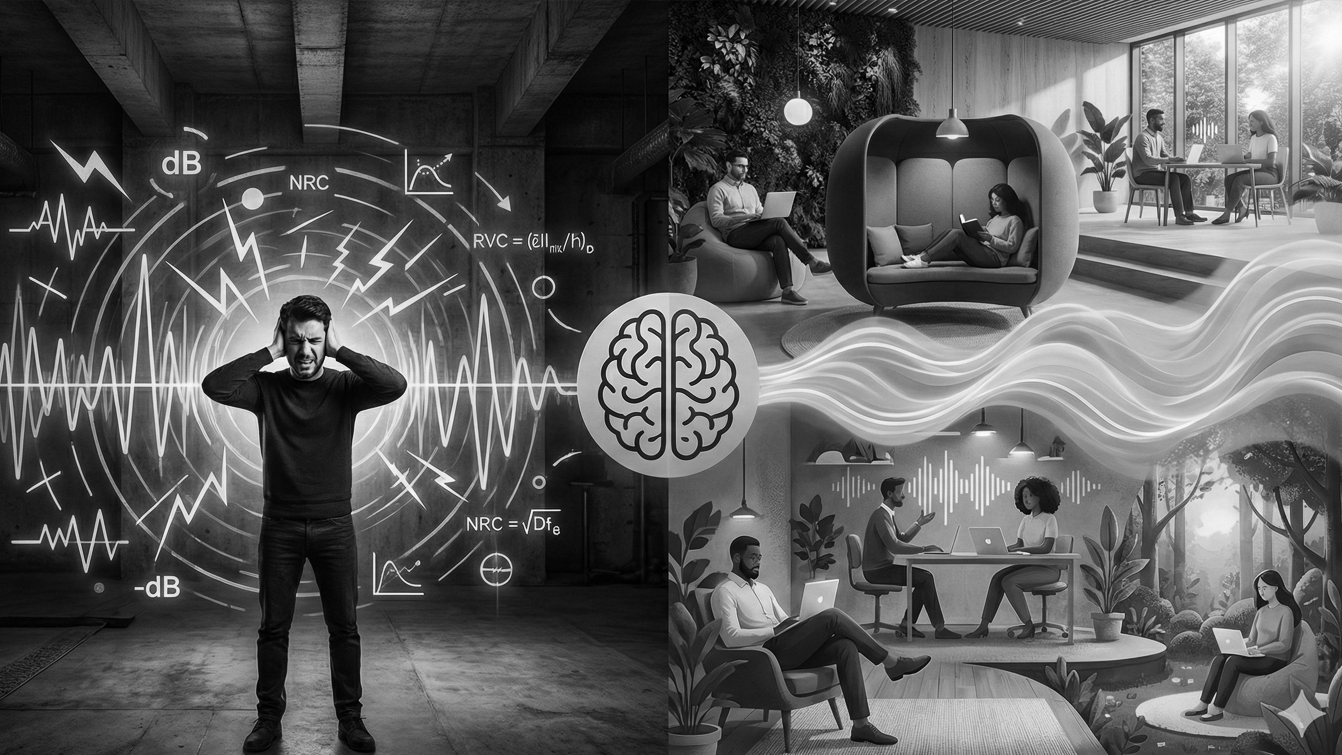
For decades, acoustic performance has been discussed in terms of numbers: decibels, reverberation time, and Noise Reduction Coefficients. These metrics still matter—but they don’t tell the full story of how people actually experience sound.
Today, a growing body of research and design practice is shifting the conversation toward psychoacoustics: how sound is perceived, interpreted, and felt. This shift is especially important as designers grapple with mental well-being, cognitive load, and neurodiversity in the built environment.
The result is a more human understanding of acoustics—one that recognizes sound as an active participant in focus, stress, and comfort.
Why Quiet Isn’t Always the Goal
A common misconception in acoustic design is that less sound is always better. In reality, the brain responds not just to volume, but to consistency, predictability, and meaning.
A space that is technically “quiet” can still feel uncomfortable if isolated sounds stand out sharply—keyboard clicks, footsteps, or a single nearby conversation. Conversely, environments with gentle, consistent background sound often feel calmer and more supportive of concentration.
This is why many modern workplaces and learning environments now focus on shaping sound rather than eliminating it. The goal is not silence, but balance.
Neurodiversity Changes the Design Brief
Neurodiversity has brought new urgency to the way we think about sound. Individuals with autism, ADHD, sensory processing differences, or anxiety often experience auditory environments more intensely than neurotypical users.
Sudden noises, reverberant spaces, or overlapping conversations can increase cognitive load and stress, making it harder to focus or feel at ease. Importantly, these challenges are not limited to a small minority—many people experience auditory fatigue in acoustically uncontrolled environments.
Designing for neurodiversity means acknowledging that there is no single “ideal” sound environment. Flexibility and choice become essential.
From Performance Metrics to Human Outcomes
Traditional acoustic metrics are useful for measuring absorption and reflection, but they don’t account for perception. Two rooms with identical reverberation times can feel completely different depending on layout, sound sources, and occupancy patterns.
This has led many designers to prioritize experiential outcomes: clarity of speech, ability to focus, reduction of stress, and overall comfort. Recent workplace studies have linked improved acoustic conditions to lower reported stress levels and higher task performance—particularly in environments requiring sustained attention.
In practice, this means evaluating acoustics not just at the drawing stage, but in relation to how spaces will actually be used throughout the day.
Designing for Choice, Control, and Recovery
One of the most effective strategies in psychoacoustic design is providing users with options. Quiet zones, collaboration areas, and transitional spaces allow people to self-regulate their sensory experience.
Acoustic zoning plays a critical role here. Absorptive ceilings, wall treatments, and spatial separation help prevent sound from overwhelming adjacent areas, while still supporting openness and connection.
Some environments also incorporate controlled background sound—often referred to as sound masking—to reduce the impact of sudden or distracting noises. When used thoughtfully, this can improve speech privacy and focus without increasing perceived loudness.
Acoustics as a Mental Health Consideration
As conversations around wellness evolve, acoustics is increasingly recognized as a mental health factor. Chronic noise exposure has been associated with elevated stress, reduced concentration, and fatigue—outcomes that affect productivity, learning, and overall well-being.
Designing acoustically supportive environments sends a clear message: that cognitive comfort matters as much as visual appeal or spatial efficiency.
For architects, interior designers, and facility managers, this represents an opportunity to move beyond compliance and toward care—creating spaces that support diverse minds, working styles, and sensory needs.
The Future of Acoustics Is Human-Centered
Psychoacoustics invites a broader question: not just how sound behaves in a space, but how people do.
By shifting focus from raw performance data to lived experience, designers can create environments that feel calmer, clearer, and more inclusive. Spaces where people can think, connect, and recover—without fighting the noise around them.
In a world that is increasingly loud and overstimulated, thoughtful acoustic design is no longer a technical luxury. It is a fundamental part of human-centered architecture.