
When people think about airport design, acoustics rarely top the list. Yet few environments demand acoustic performance more than a modern airport — especially within security screening areas where stress levels are high, instructions must be clearly understood, and thousands of people move through the space every hour.
At YYC Calgary International Airport, Phase I of the new Centralized Security Screening facility represents a major shift in how passengers experience security. Behind the scenes, it also became the largest and most complex acoustic project Hush has completed to date.
This is a look at what it takes to deliver acoustic performance at airport scale — and why good acoustics matter as much for screening staff as they do for passengers.
Why Airport Screening Acoustics Are Uniquely Challenging
Airport security halls are acoustically unforgiving by nature. They are designed for durability, safety, and high traffic — which typically means hard surfaces like concrete, tile, glass, and metal dominate the space. These materials reflect nearly 100% of sound energy, causing reverberation to build rapidly.
Add to that high ceilings, fluctuating crowd density, rolling luggage, public address systems, and continuous movement, and the result is an environment where noise compounds quickly.
In a centralized screening model — where multiple checkpoints are consolidated into one large volume — these challenges are amplified. Poor acoustics don’t just create discomfort; they directly impact communication, efficiency, and safety.
From the outset, acoustics at YYC needed to support:
- Clear speech intelligibility between screening staff and passengers
- Reduced ambient noise in a high-stress, high-volume environment
- A calmer experience for staff working long shifts
- Seamless integration with a refined architectural design
- Full compliance with public safety and engineering standards
Acoustics Matter for Screening Staff — Not Just Passengers
While passenger experience is often the focus, screening staff spend extended periods of time in these demanding acoustic environments. Prolonged exposure to elevated noise levels can lead to fatigue, stress, and long-term health concerns.
The Occupational Safety and Health Administration (OSHA), part of the Centers for Disease Control (CDC), identifies noise-induced hearing loss as one of the top occupational concerns in the workplace. OSHA requires employers to implement hearing conservation programs that include testing, education, and protective tools.
Both the Environmental Protection Agency (EPA) and the World Health Organization (WHO) recommend that daily noise exposure not exceed 70 decibels — a threshold that can be easily surpassed in untreated screening halls.
Reducing reverberation time (RT) is a critical part of controlling noise buildup. In spaces dominated by hard, reflective surfaces, introducing highly absorptive materials is essential to restoring balance. Acoustic felt solutions play a key role in absorbing sound energy, preventing it from continually reflecting back into the space.
Stepping In Under Pressure
Hush was brought into the YYC project after the original acoustic supplier was unable to meet the required timeline. With construction already underway, there was little room for delay — and no opportunity for off-the-shelf solutions.
Working alongside DIALOG, Hush was tasked with designing and delivering a fully custom acoustic solution that met the architectural intent while performing at an unprecedented scale.
Designing Beyond Standard Systems
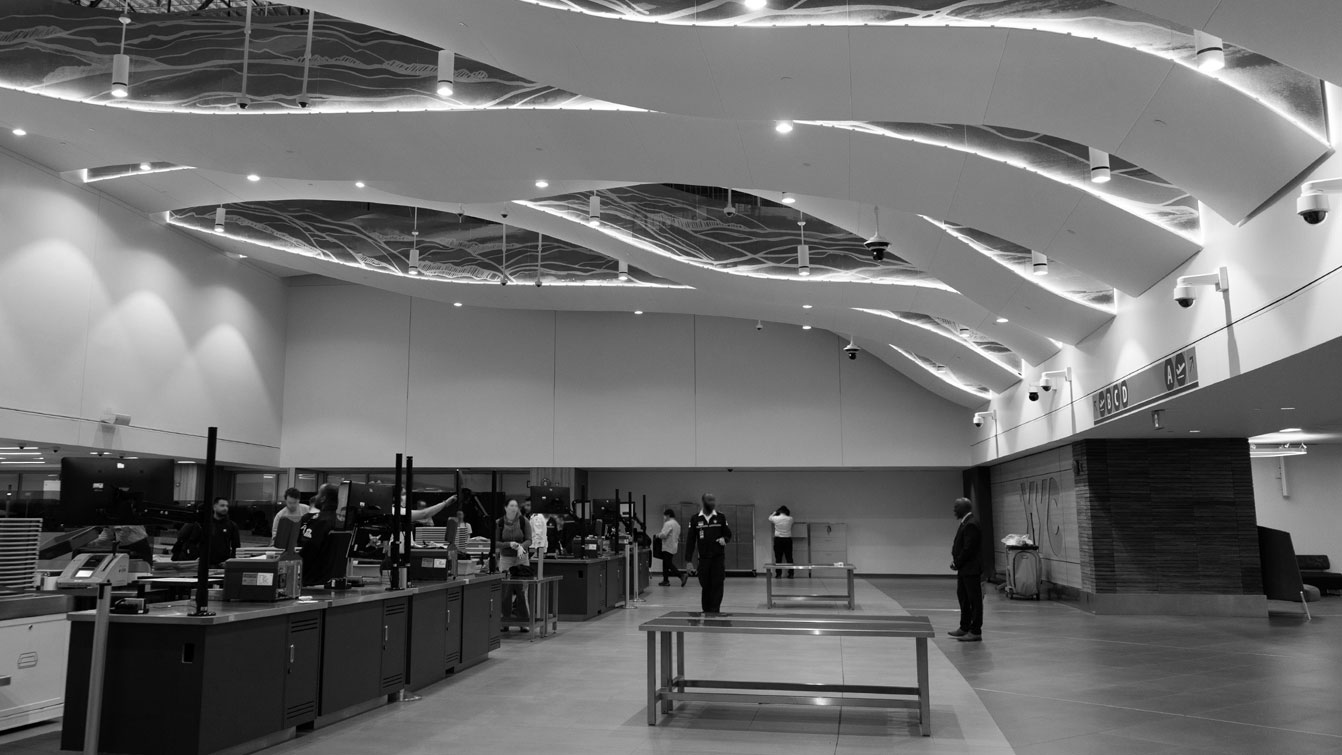
The solution centered on large, suspended acoustic cloud systems engineered specifically for the Centralized Security Screening facility. These were not standard products adapted to fit — they were designed from the ground up to address the unique acoustic conditions of the space.
Key considerations included:
- Custom geometries aligned with the architectural rhythm of the terminal
- High acoustic absorption to reduce reverberation and support speech clarity
- Integration with lighting, mechanical systems, and sightlines
- A visual presence that enhances the space without overwhelming it
By introducing highly absorptive felt surfaces into an environment dominated by hard materials, the system significantly reduced RT and improved overall acoustic comfort for both staff and passengers.
Engineering Collaboration at Scale
Given the size, weight, and public nature of the installation, third-party engineering validation was essential. Structural engineers reviewed the concepts, with Hush’s technical team collaborating closely to refine suspension methods and hardware requirements.
Much of the mounting system combined commercially available components with project-specific adaptations — ensuring safety standards were met while maintaining the clean, floating appearance of the acoustic clouds.
Projects of this scale succeed or fail on collaboration. At YYC, close coordination between architects, engineers, and manufacturers was critical to keeping the project on track under tight deadlines.
From Concept to Completion
Manufacturing and delivery were executed on a compressed timeline without compromising performance or quality. Today, the completed installation serves every passenger and screening officer passing through YYC’s centralized screening area — a space designed to feel calmer, clearer, and more controlled despite its scale and complexity.
Lessons from Airport-Scale Acoustics
The YYC project reinforced several principles that extend far beyond airports:
- Acoustics scale with intent, not just size
- Staff wellbeing is a critical acoustic performance driver
- Hard surfaces demand intentional acoustic balance
- Custom solutions reduce risk when engineering leads the process
- Acoustics shape experience — they are not an afterthought
For Hush, this project was a defining moment — a demonstration of what’s possible when acoustic design is treated as essential public infrastructure.
Looking Ahead
With Phase I now open and future expansions planned, YYC’s Centralized Security Screening facility sets a new benchmark for airport design in Canada. For Hush, it represents both a milestone project and a blueprint for delivering clarity, comfort, and confidence in the most demanding environments.
Want to talk acoustics? If you’re designing a large-format public space and need acoustic performance without compromising architectural intent, Hush can help.