
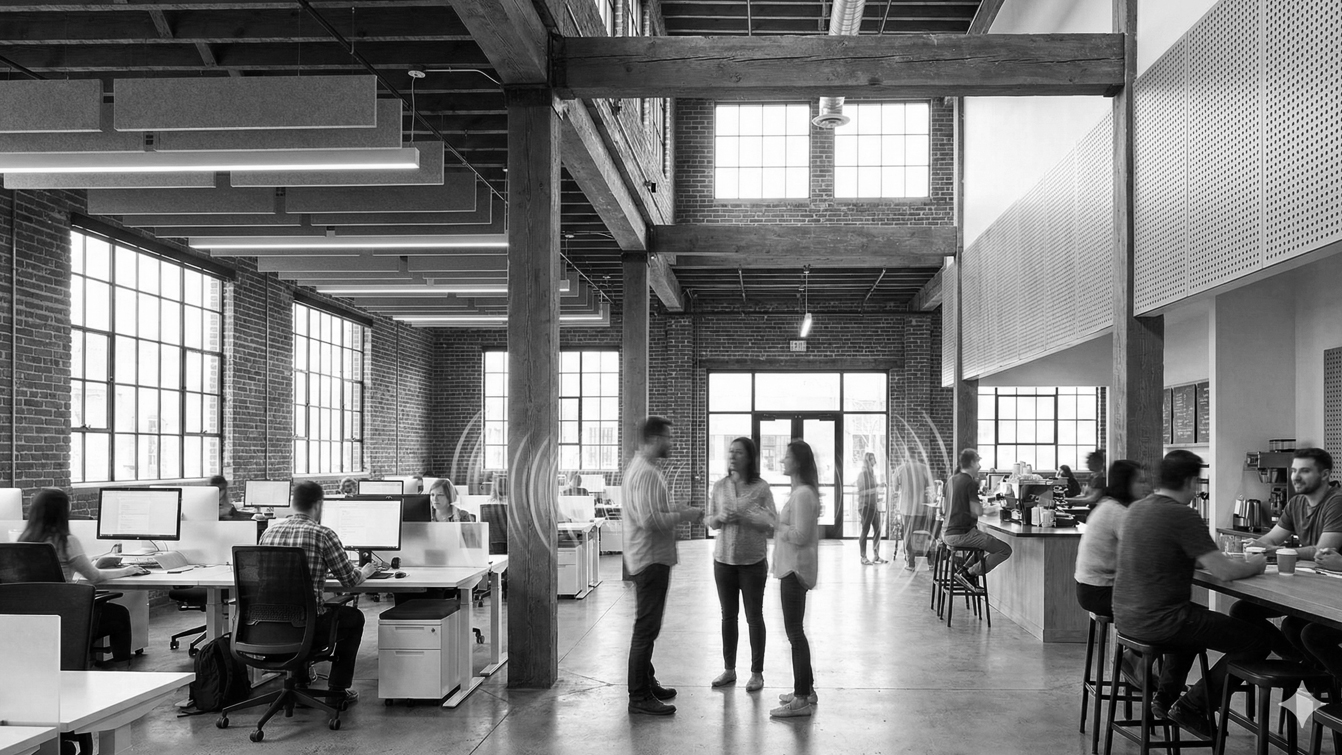
Adaptive reuse is having a moment across Canada and North America. Warehouses become workplaces. Factories turn into hotels. Churches re-emerge as cultural venues. And on opening day, these spaces often look absolutely incredible—exposed brick, polished concrete, heavy timber, soaring ceilings, and daylight everywhere.
But once the space fills with people, a familiar problem tends to surface fast: sound. Conversations bounce. Noise travels. Focus drops. Privacy disappears. The building’s best aesthetic features can quickly become its biggest acoustic liabilities.
Welcome to the adaptive reuse acoustic blind spot—where the design narrative is strong, but the soundscape is struggling.
Why Historic Conversions So Often Sound “Wrong”
Most heritage and industrial buildings were never built for modern occupancy. They were designed for manufacturing, storage, worship, or circulation—not for today’s dense mix of meetings, collaboration, hospitality, and multi-use programming.
Acoustically, the material palette that makes these spaces iconic is also notoriously reflective. Brick, stone, concrete, steel, and glass do not absorb much sound. Add big open volumes and high ceilings, and you get reverberation that lingers far longer than it should.
The result is predictable:
- Speech becomes harder to understand at normal volumes.
- Background noise rises as people unconsciously speak louder to compensate.
- Work zones and social zones bleed into each other.
- Guests and tenants experience listener fatigue—often without knowing why.
In other words: the space may be visually calm, but acoustically chaotic.
The Preservation Dilemma: You Can’t Just Cover Everything Up
In new construction, acoustics can be “built in” with softer finishes and tailored assemblies. In adaptive reuse, the architecture itself is often protected, celebrated, or both. Those brick walls and exposed beams are the point. Covering them entirely can undermine the story of the building.
This is where many projects get stuck: the design intent demands authenticity, but the user experience demands comfort.
The best adaptive reuse projects resolve this tension by treating acoustics as a design material—one that can be layered in without erasing the past.
The Rise of “Invisible” Acoustic Interventions
A clear trend in adaptive reuse is the move toward acoustic solutions that feel intentional but visually restrained—quiet performance without heavy visual disruption.
One of the most effective places to work is the ceiling plane. Even when designers want to keep an exposed feel, suspended systems can be introduced in a way that preserves volume and structure while controlling reverberation. Baffles and clouds, for example, can visually reinforce rhythm, geometry, and zoning—while dramatically improving speech comfort.
Walls also offer opportunities when approached thoughtfully. Instead of treating acoustic panels as add-ons, many teams now integrate them like architectural elements: textured fields, art-forward compositions, or material moments that complement existing brick and timber rather than compete with them.
In short, the strategy isn’t to hide acoustics. It’s to design it.
Mixed-Use Adaptive Reuse Raises the Stakes
Another major shift: adaptive reuse projects are increasingly mixed-use. Offices above restaurants. Event spaces next to residential units. Hotel lobbies flowing into co-working and bar areas. These adjacency decisions create acoustic risk—especially in older structures with unknown assemblies, limited isolation, and abundant flanking paths.
This is why many teams are bringing acoustic thinking earlier into the process:
- Evaluating existing floor and ceiling assemblies for sound transmission
- Identifying vibration pathways for new mechanical systems
- Planning acoustic zoning so quiet and lively programs can coexist
- Designing for privacy where it matters—meeting rooms, wellness spaces, guest rooms
Retrofits are always possible, but the most successful projects treat acoustics as foundational—not corrective.
Acoustic Comfort Is Part of “Making the Old Work Again”
Adaptive reuse is ultimately about giving a building a second life. But for that second life to thrive, it has to feel good to live, work, gather, and host in—not just look good in photos.
When acoustics are handled well, something subtle but powerful happens: the space feels intentional. Conversations feel easier. People stay longer. Stress drops. The building’s character remains intact, but the experience becomes genuinely modern.
In today’s adaptive reuse landscape, acoustics isn’t a technical afterthought—it’s one of the quiet decisions that determines whether a historic conversion becomes a beloved destination, or a beautiful space people struggle to use.